
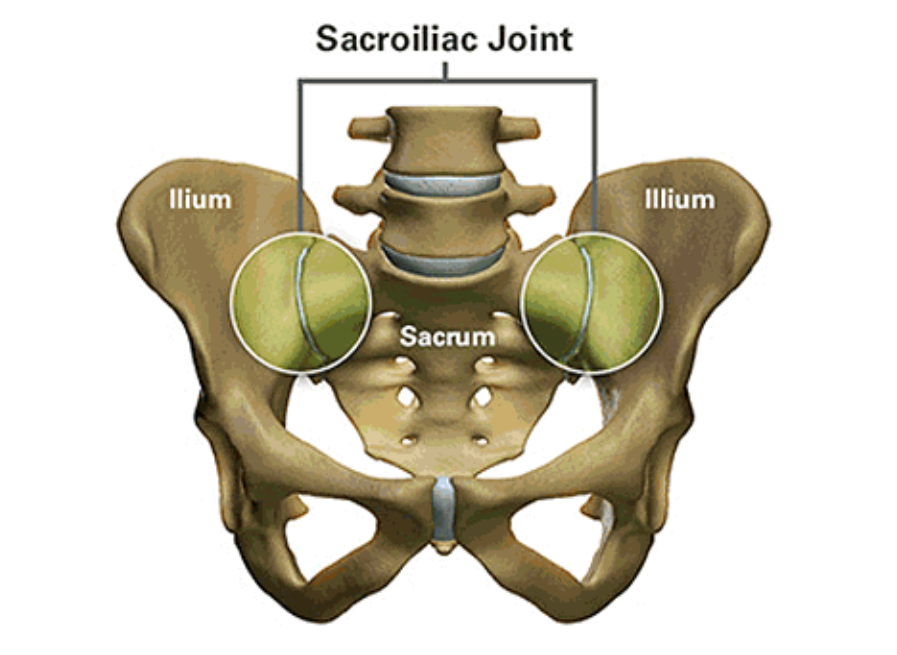
The sacroiliac joints. Where are they and why they might be the cause of your back pain!
Millions of years ago our ancestors walked on all fours. Their weight bearing joints were strong and stable ball and socket joints in the hips and the shoulders!
Fast forward to today, we have an upright posture, walk on two legs. Now, while we still bear weight through the strong hip joints, we must transfer our upper body weight through the sacroiliac joints first!

As osteopaths, when someone presents complaining of low back pain, hip pain or sciatica, we are always suspicious that the joint responsible may very well be the sacroiliac joint.
Simply because of its evolutionary origins it is more vulnerable to injury and imbalance in our modern posture.
Also, because the SIJ relies on ligaments for a lot of its support, it is also a joint that can be impacted by hormonal shifts in the body such as perimenopause and pregnancy.

The anatomy of the Sacroiliac Joints.
Our osteopath, Caitlin Parker, takes a look at the more detailed anatomy of the sacroiliac joints (SIJ) below.
The sacroiliac joints (SIJ) are located at the back of the pelvis on both the right and left sides and connect the pelvis to the spine. It is made up of the tailbone (sacrum) and the two big fan-like bones of the pelvis (illium). The sacrum has four pairs of holes (foramina) that allow for the spinal nerves to pass through.
The sacroiliac joints provide stability to the body as well as being shock absorbers and an energy transfer site between the legs and spine when moving. The SIJ’s are particularly functional when standing and in walking, running, getting out of a chair and rolling over in bed. Rather than being a self supporting joint, the stability of the pelvis comes from ligaments, tendons and muscles. There are approximately 35 muscles that attach to the pelvis that function to stabilise it rather than to cause movement!
Low back pain is one of the top three presentations we see in clinical practice. It is estimated that 27% of low back complaints are due to dysfunction in the SIJ.
Pain from the SIJ can be the result of a biomechanical dysfunction from trauma, like a fall or a car accident, or sometimes even a heavy footstep off a curb or step. Pain can also come from hypermobility, general wear and tear, pregnancy, or an autoimmune condition.
What does Sacroiliac Joint pain feel like?
SIJ pain is usually located in the lower back or buttock region. It can be one sided or on both sides. Because of its close association with the nerves coming from the lower spine, it can send pain further into the buttock, groin, outer thigh or back of the leg. This pain is often describes as sciatica. SIJ pain can be worse in the morning and more intense when standing from a seated position, prolonged sitting, prolonged standing or with climbing stairs.

What does an osteopath do for Sacroiliac Joint pain?
When we assess you for sacroiliac joint strain we will watch you stand and bend. We watch the way that your pelvis moves and look for any imbalance in the joint or tension and restriction in the surrounding muscles. Sometimes one sacroiliac joint will be restricted in movement while the other one can be overloaded. Treatment always aims to balance the load to avoid both overuse and restriction. At Oak Tree Osteopathy we use a variety of techniques to do this. Depending on the individual person, we may use massage, trigger point therapy, dry needling, joint movement and stretching.
We are always aiming for long term improvement and so your osteo will also figure out why your pain started in the first place. Was it an injury, a repetitive loading problem or affected by desk or sleep posture? We then develop a strengthening plan to stop it happening again.
What should I do next?
If you feel that your sacroiliac joint may be the root cause of your low back, hip pain or sciatica, book a consultation here to get an osteopathic approach to SIJ management.